
Dryer Heat and Airflow
Do
- Call now about cold or slow-drying laundry.
- Stop the dryer at its control if safe.
- Clean the lint screen with the dryer off.
- Describe visible vent damage during the call.
Don’t
- Open the dryer cabinet to test electrical parts.
- Run repeated cycles through a burning smell.
- Loosen gas fittings or adjust the gas valve.
- Bypass a fuse or use an extension cord.
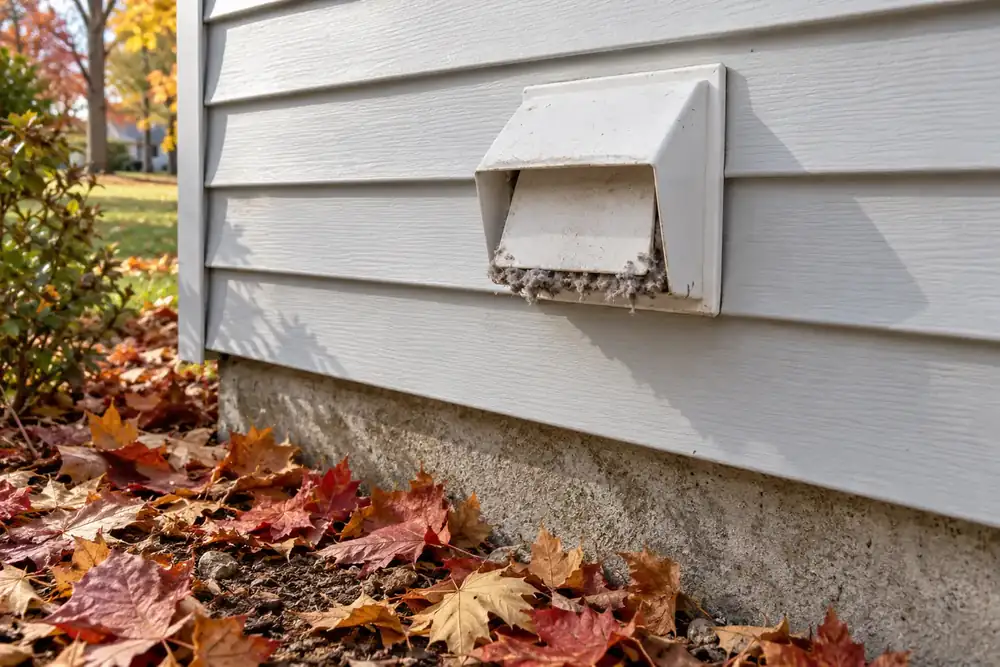
Common Causes of Lost Dryer Heat
A dryer that tumbles without heating needs diagnosis of its heat source and power supply; a dryer that feels hot but leaves clothes damp also needs an airflow check. Call with either symptom now. The difference helps your technician choose where to start, but it doesn't prove which part has failed.
Lint and restricted exhaust
Lint buildup and a restricted vent can leave clothes damp by limiting the escape of moist air. The U.S. Fire Administration's dryer-safety advice calls for a clean lint filter, an unrestricted vent and an outdoor covering that opens during operation. A crushed duct or unnecessarily long vent run also needs attention. Visible lint at the outside hood doesn't reveal the condition of the full duct.
Do:
- Call about long drying times and visible vent restrictions.
- Clean the lint screen while the dryer is off.
- Look at the outside flap from a safe ground-level position.
- Describe any visible crushed duct without moving the dryer.
Don't:
- Run the dryer without its lint screen.
- Climb to reach an elevated vent hood.
- Pull a gas dryer away from its connections.
- Keep adding cycles when the appliance overheats.
Load size and cycle settings
An overloaded drum or an unheated cycle can explain damp clothes without proving a heating part has failed. A packed load leaves less room for clothes to tumble. Whirlpool's drying advice distinguishes load and setting problems from heating failures. Share the selected cycle and whether every load has the same problem during your call.
Do:
- Call about a recurring drying problem.
- Check the selected cycle with the dryer stopped.
- Follow the manual's load-size instructions for future use.
Don't:
- Pack the drum tightly with heavy towels.
- Select higher heat to overcome a suspected blockage.
- Treat one damp item as proof of element failure.
Electric dryer heat and power
An electric dryer may turn without heating when part of its power supply is lost. Whirlpool's technician reference also identifies heating-element and thermal-protection faults; a failed thermal fuse or thermostat is another possibility. These are checks for your technician, rather than reasons to remove the cabinet. Dryer repair involving a heating element also needs a check of why the part failed, particularly when restricted airflow or overheating is involved.
Do:
- Call and describe whether the drum still turns.
- Turn the dryer off using a safely reachable control.
- Reset a tripped breaker once if conditions and access are safe.
- Leave it off if the breaker trips again.
Don't:
- Open a cabinet or electrical panel cover.
- Test live wiring or bridge a thermal fuse.
- Assume a running drum means the heat circuit works.
Gas dryer heating faults
A gas dryer that turns without heat may have a supply issue, failed igniter or gas valve coil. Whirlpool's dryer-parts overview describes the igniter and valve components as parts of the heating system. An accessible supply-valve position is a visual observation only: leave the handle and fittings untouched. A gas odor changes the response to immediate evacuation, rather than troubleshooting.
Do:
- Call about no heat when there is no gas odor.
- Describe the visible valve position without touching it.
- Leave for gas odors; call 911 and the utility outside.
Don't:
- Adjust a gas valve or loosen a connection.
- Try to light the burner yourself.
- Switch controls or unplug anything where you smell gas.
Symptoms to share during the call
The symptoms below suggest starting points, while your technician determines the actual fault. Dryer repair and vent cleaning address different parts of the drying path; describe both appliance symptoms and visible exhaust problems when calling.
| What you notice | Usually behind it | Do now | Don't |
|---|---|---|---|
| Drum turns but air stays cold | Unheated setting, lost power or heating fault | Call and describe the cycle | Open the cabinet |
| Clothes stay damp in a hot drum | Restricted airflow or an oversized load | Call about drying time | Repeat overheated cycles |
| Outside flap stays shut | Lint restriction or a stuck flap | Report the visible obstruction | Reach into the duct |
| Breaker trips again | Appliance or household circuit fault | Leave the dryer off and call | Reset repeatedly |
| Gas odor near the dryer | Possible gas leak | Leave; call 911 outside | Touch switches or plugs |
Do:
- Call with the symptom that best matches your dryer.
- Mention whether the problem changed gradually or started suddenly.
Don't:
- Buy a replacement part from the symptom alone.
- Remove covers to get a closer look.
What affects heating repairs
Heating-element cost for dryer repair depends on the correct part, access and the diagnosis. One of our local appliance repair partners outlines those factors and the proposed work before starting. The appliance repair cost page covers additional factors without treating every loss of heat as the same repair.
Do:
- Call to discuss the symptom and repair scope.
- Ask what caused the failed part.
Don't:
- Assume a new element fixes an obstructed vent.
- Compare repairs using a parts listing alone.