
Safe First Moves
Do
- Call now about the appliance and its symptoms.
- Leave immediately for gas smells; call 911 from outside.
- Keep children and pets away from the appliance.
- Turn controls off only when safe, without gas odors.
Don’t
- Assume it is safe to open a microwave for repair.
- Touch switches or plugs where you smell gas.
- Run another cycle through leaking water or sparks.
- Reach across wet floors toward outlets or appliance cords.
Safety Steps for Common Appliance Problems
A broken appliance needs a repair call, with immediate emergency help for gas odors or fire. Describe what happened during the call; a model number, photo or completed checklist isn't a condition for getting help. Safe observations help your technician distinguish a leak, heating fault or power problem without asking you to dismantle anything.
Water on the floor
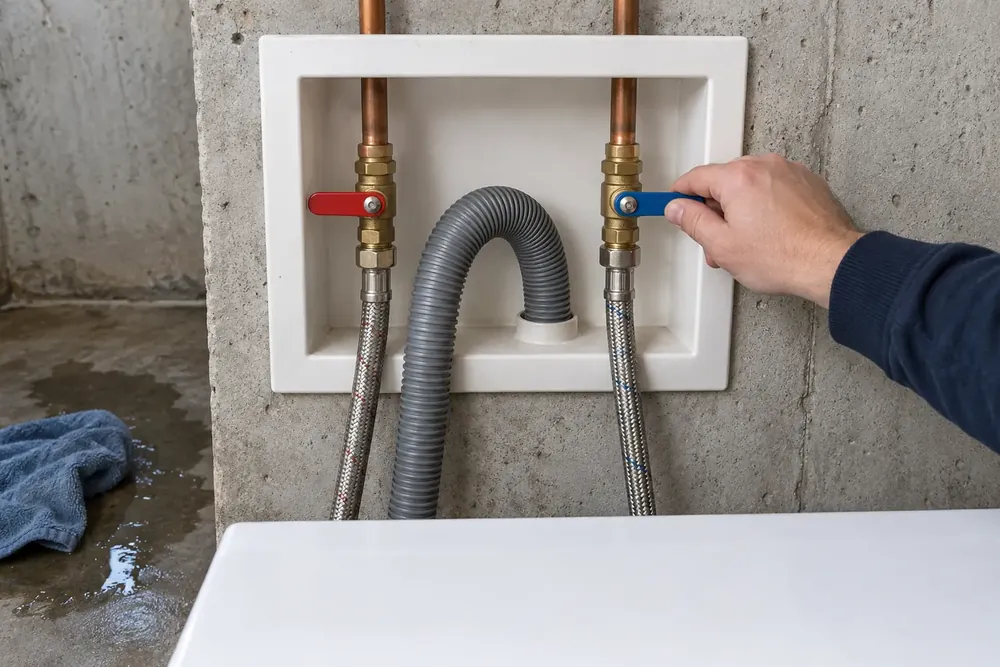
Water from a washer, dishwasher or refrigerator supply line means stop using the appliance and stay clear of wet electrical connections. A visible puddle doesn't identify the failed part. For who to call for a leaking washing machine, start with washer repair; your technician checks the appliance and its connections.
Do:
- Call and ask who can fix my dishwasher near me.
- Stop the appliance using dry, safely reachable controls.
- Close the accessible washer or under-sink water valve if safe.
- Wipe up water only away from electrical hazards.
Don't:
- Step into water to reach a plug.
- Pull out a heavy fridge to find a leak.
- Disconnect hoses or restart a leaking machine.
Gas odor near a range or dryer
A gas smell means leave immediately and call 911 from outside. Unitil's gas-safety advice says to evacuate and avoid anything that could create a spark. The same emergency response applies near an oven, cooktop or gas dryer; locating the leak belongs to emergency personnel.
Do:
- Get everyone outside and away from the building.
- Call 911 from a safe location outside.
- Notify your gas utility from outside.
- Ask who can fix my stove while staying safely outside.
Don't:
- Switch lights or appliances on or off.
- Unplug anything or use a phone indoors.
- Light a match or touch gas fittings.
- Return until emergency responders say it is safe.
Burning smells from a dryer or oven
An unusual burning smell means stop using the appliance; smoke or flames mean leave and call 911. Repeated cycles aren't a useful test. The U.S. Fire Administration identifies appliance and electrical fire hazards and warns against extension cords for major appliances.
Do:
- Call for repair help if there is no active fire.
- Ask who can fix my oven and describe the odor.
- Turn the control off only if safely reachable.
- Keep people away while the appliance cools.
Don't:
- Run a hotter cycle to burn away the smell.
- Reach behind a hot appliance or remove its panel.
- Put water on an electrical or grease fire.
Sparks inside a microwave
Sparks mean stop the microwave and keep its outer case closed. The U.S. Consumer Product Safety Commission warns that an unplugged microwave can still cause electrical shock, so it is dangerous to repair a microwave yourself. For anyone wondering whether it is safe to repair a microwave, internal work belongs with a professional.
Do:
- Call about the sparking and leave the case closed.
- Stop cooking using the control if safe.
- Leave for fire or spreading smoke; call 911 outside.
Don't:
- Repeat the cycle to check whether sparks return.
- Remove covers or reach into internal electrical parts.
- Assume unplugging removes every electrical hazard.
A fridge or freezer stops cooling
Lost cooling means protect the food while arranging repair. FoodSafety.gov gives power-outage limits of up to four hours for a closed refrigerator and approximately 48 hours for a full freezer, or 24 hours for a half-full freezer with its door closed. The limits assume food was cold when power failed; unnoticed warming needs temperature-based decisions. Its chart says to discard meat, milk and other listed perishables held at 40°F or above for more than two hours.
Do:
- Call now about the cooling failure.
- Ask who can fix my ice maker during the repair call.
- Keep doors closed as much as possible.
- Use the food-safety chart to decide what to discard.
Don't:
- Taste food to judge whether it is safe.
- Treat a working light as proof of cooling.
- Keep opening the freezer to check its contents.
A breaker or outlet trips
A tripped breaker or GFCI needs attention if it trips again after one reset. A reset is optional and only safe with dry hands, dry footing and no gas odor, burning smell or visible damage. Your technician handles appliance faults; an electrician handles faults in the household circuit.
Do:
- Call and report which appliance lost power.
- Turn the appliance off at its control if safe.
- Reset once only when the breaker or outlet is safely accessible.
Don't:
- Keep resetting a breaker or GFCI that trips again.
- Remove a panel cover or handle wiring.
- Use an extension cord to bypass the problem.
Children or pets near a hot appliance
Children and pets need to stay away from hot surfaces, open doors and a damaged appliance. An open oven or dishwasher door creates a reach or climbing hazard even when the controls are off. For nonemergency repairs, one of our local appliance repair partners explains the work and its cost before starting.
Do:
- Call about a door that won't close or latch.
- Move children and pets to another room.
- Keep the area clear while hot surfaces cool.
Don't:
- Leave an open appliance accessible to children.
- Let anyone climb on an oven or dishwasher door.
- Force a damaged latch or prop a door open.